
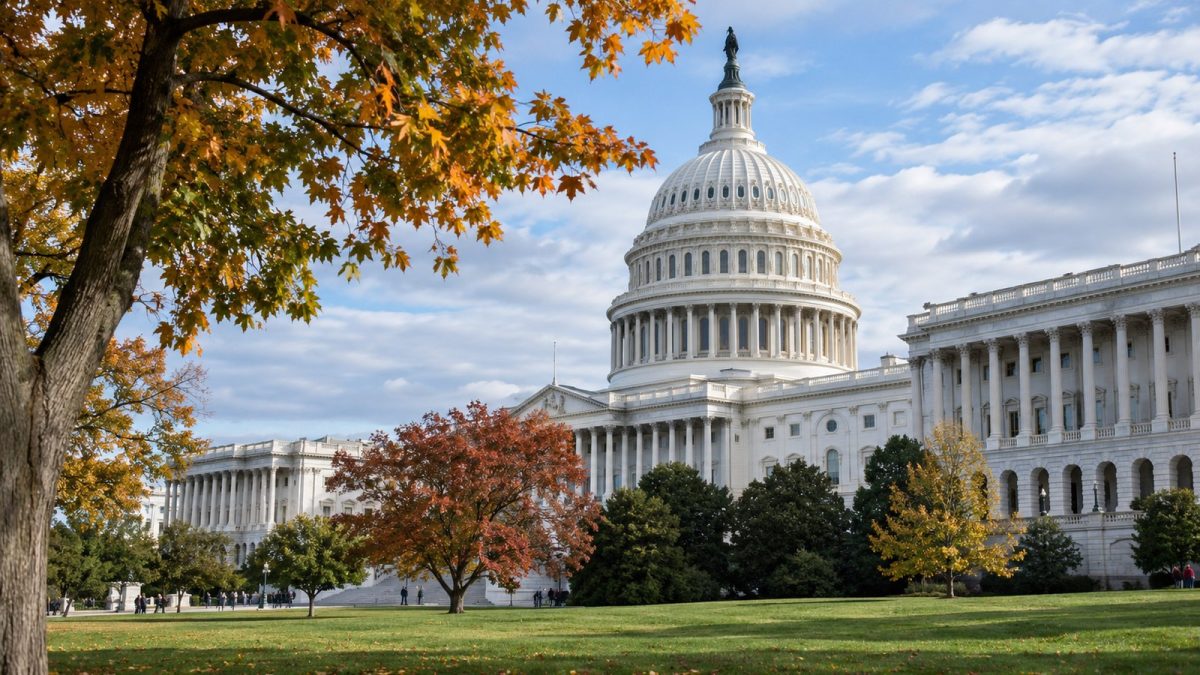
The US midterm elections on 3 November 2026 decisively changed the balance of power in Washington. Democrats won control of both the House of Representatives and Senate while President Donald Trump remained in the White House. The result does not immediately overturn existing economic policies, but beginning in 2027 it changes the negotiations required to pass legislation, approve federal spending, authorize borrowing and scrutinize the executive branch.
Markets must distinguish a transfer of congressional control over spending from presidential powers over tariffs, national security and diplomacy that continue under existing law. It would be unjustified to assume that all import duties will disappear, the dollar will keep falling or the Middle East conflict will end because of the election alone.
This analysis uses the Associated Press's calls of majority control and market closes through 5 November 2026 in the United States. It distinguishes the projected control of each chamber from final, legally certified district-by-district tallies, some of which remained incomplete.
How the 2026 elections changed control of Congress
Before the election Republicans controlled both chambers. The Senate had 53 Republicans, 45 Democrats and two independents aligned with Democrats. Republicans held a narrow House majority, although vacancies and an independent member meant the actual membership differed from the nominal 435 seats.
AP called Democratic control of the Senate at 11:36 p.m. US Eastern on 3 November (11:36 a.m. on 4 November in Thailand) and of the House at 1:24 a.m. Eastern on 4 November (1:24 p.m. in Thailand). Reuters reported on 4 November that the Democratic-aligned Senate caucus had at least 54 seats against 44 Republicans, with some races unsettled, while Democrats had gained at least 30 House seats.
| Issue | Before the 2026 election | Confirmed as of 6 November 2026 |
|---|---|---|
| House of Representatives, 435 seats | Republican majority | AP called Democratic majority; exact seats await certification |
| Senate, 100 seats | 53 Republicans, 45 Democrats, two D-aligned independents | At least 54 D-aligned against 44 Republicans, according to Reuters on 4 November |
| Executive branch | President Donald Trump | Trump remains president; midterms did not elect a president |
| New Congress takes office | Current Congress until term ends | 3 January 2027, under the 20th Amendment |
| When | Event | Economic or policy significance |
|---|---|---|
| 3 Nov 2026 US time | Election for all 435 House seats and Senate seats due or contested in special elections | Markets update balance-of-power expectations; existing laws remain valid |
| 3 Nov 23:36 EST / 4 Nov 11:36 Thailand | AP calls Democratic Senate majority | New leverage over confirmations and committees |
| 4 Nov 01:24 EST / 4 Nov 13:24 Thailand | AP calls Democratic House majority | Greater influence over the budget agenda and oversight |
| 4-5 Nov 2026 | Equities, bonds, dollar and oil move in different directions | Separate political expectations from oil prices and company news |
| 3 Jan 2027 | The 120th Congress begins | New legislative power balance takes effect |
These are majority-control projections, not a claim that all seats have been legally certified. Full legislative powers change hands when the newly elected members take office, not when markets first react to the results.
What power changes hands and what Trump can still do
The American system divides authority among Congress, the president and the courts. Control of both chambers gives Democrats more power to set the legislative agenda, lead committees, conduct hearings and executive oversight, negotiate spending and debt-limit bills and review federal expenditure. The Senate also determines confirmation of cabinet nominees, judges and other senior officials.
Yet the administration retains executive powers conferred by existing statutes. The president may veto enacted bills, while ordinary Senate legislation may face the filibuster: in many cases 60 votes are required to close debate. Winning a simple majority therefore does not enable a party to change every law unilaterally.
| Policy | Congress's increased influence | Executive powers or constraints that remain |
|---|---|---|
| Income tax and tax laws | Changing statutory tax bases or benefits requires new legislation | Presidential veto remains; major revisions need negotiation |
| Annual budget and debt ceiling | Congress authorizes spending and borrowing limits | Failure to agree risks shutdowns or debt-payment disruption |
| Tariffs and trade | Oversight, review of delegated powers and appropriations leverage | Existing trade-law powers can remain with executive; veto constrains broad repeal |
| Foreign policy and security | Budget, scrutiny and statutory war powers | President retains operational and diplomatic authority within law |
| AI and financial regulation | Hearings, new laws and scrutiny of regulator appointments | Regulators can act under existing law and lawful orders |
The essential change is not that one party automatically wins each policy dispute. Washington moves from a more aligned presidency and Congress toward bargaining between institutions controlled by competing political parties.
Taxes, spending and federal debt may become the costliest bargaining points
Congress has leverage through appropriations and tax legislation, but cannot simply erase laws already enacted by a single vote. Provisions enacted under the 2025 tax law remain in effect unless subsequent legislation or a relevant judgment changes them. Companies must plan using current law while allowing for additional conditions or reduced financing for future government programs.
The fiscal backdrop makes that bargaining consequential. The US Treasury's figures for fiscal 2026, which ended on 30 September, put receipts at approximately 5.403 trillion USD, outlays at 7.396 trillion USD, and the deficit at 1.992 trillion USD. The fiscal 2025 deficit was about 1.775 trillion USD, implying a rise of roughly 12%. These are completed fiscal-year results, not forecasts produced after the election.
The Congressional Budget Office also identifies debt and interest costs as long-term pressures. Its February 2026 baseline projected federal debt held by the public at roughly 101% of GDP in 2026, on a rising path absent policy changes. The question is therefore not merely who wins each vote but whether lawmakers reach agreements before funding and debt-limit deadlines.
Allianz Research suggested on 4 November that prolonged disagreement could create shutdown or debt-ceiling confrontations during 2027 or early 2028. That is an analyst scenario, not a confirmed date for a shutdown or default. Allianz also observed potential room to negotiate defense, health-care and civilian spending.
Bond-market implications run both ways. Lower expectations of fiscal expansion might pull long-term Treasury yields down. But political disputes that damage confidence in debt management could raise the risk premium investors require. Political gridlock does not guarantee lower borrowing costs.
Import tariffs could change more slowly than investors expect
The election itself did not cancel tariffs. It must also be distinguished from the US Supreme Court's ruling of 20 February 2026 in the jointly considered matters Learning Resources, Inc. v. Trump and Trump v. V.O.S. Selections, Inc. (Nos. 24-1287 and 25-250). The Court held that the International Emergency Economic Powers Act, or IEEPA, does not authorize the president to impose import tariffs under that emergency statute. The ruling did not automatically remove powers granted by separate trade laws such as Section 301; those require independent examination. Questions about refunds of previously collected duties also follow their own procedures.
Reuters noted that Democratic majorities could investigate trade policy and propose statutory tariff limits, but Trump could veto bills he opposed. Overriding a veto requires a two-thirds majority in both chambers, not a simple majority. Global exporters therefore should not assume all existing duties will disappear on 3 January 2027.
For companies selling into the United States, the issue goes beyond the headline tariff rate. Executives must determine which duties remain legally enforceable, how any court-driven refunds may work, and who bears the charges through supply chains. Electronics, machinery, cars and consumer goods face different exposures according to their production origins and the share of US sales.
The dollar, bonds and equities did not move in one direction
The first two sessions after the result reveal markets repricing several risks simultaneously. Reuters reported that on 4 November the S&P 500 closed up 1.6%, while the ten-year US Treasury yield fell about six basis points to 4.89% as bond prices rose. Brent oil fell sharply amid hopes that the Middle East conflict might ease.
On 5 November, however, the S&P 500 fell 4.4% and Nasdaq dropped 5.5%. Investors reassessed interest rates and financing costs, corporate earnings, energy and trade risks, and the selloff in chipmakers and companies exposed to AI data-center investment. That technology weakness was one reported factor, not proof that the election alone caused the broad decline.
| Market or asset | 4 November 2026 | 5 November 2026 and interpretation |
|---|---|---|
| US equities | S&P 500 +1.6% | S&P 500 -4.4%, Nasdaq -5.5%; technology and AI investment concerns among drivers |
| 10-year US Treasury | Yield down ~0.06 percentage point to 4.89% | Yield near 4.84% per Reuters; inflation and fiscal risk still under review |
| US dollar | Initially weakened after the result | Partial rebounds with oil and yield shifts; no straight-line trend |
| Brent oil | Down over 8%, below 100 USD per barrel | Partly rebounded ~3%-4% amid war and supply uncertainty |
| Chip and data-center stocks | Markets reassess AI capital and regulatory costs | Philadelphia Semiconductor Index ~-12.2%, according to Reuters |
Three links matter: oil prices shape inflation expectations; inflation affects interest-rate pricing and bonds; and borrowing costs and investment rules influence the valuation of growth stocks. Analysts must separate policy expectations from short-term flows and company-specific news.
Oil is a channel from US politics to global inflation
The US-Iran war overlapped with the election. Reuters reported that some traders interpreted the new congressional balance as possible pressure to reconsider the conflict, helping send Brent lower on 4 November. But the presidency retains foreign-policy and security powers under applicable law, and actual shipping through the Strait of Hormuz does not improve automatically because traders anticipate a political shift.
Sustained lower oil prices could ease freight and inflation pressures for importers such as Thailand, Japan and parts of Europe, supporting purchasing power and fuel-intensive businesses while constraining some producers' revenue and investment. If the conflict persists or broadens, shipping insurance and energy costs may rise again. The key distinction is between market prices reflecting expectations and physical volumes that can actually be delivered.
Effects on global companies depend on revenues and costs
The election is not a direct trading signal for multinational stocks. Companies instead need to reassess customs costs, manufacturing footprints, public-procurement contracts, cash flows and financing costs. Importers, exporters, carmakers and parts suppliers, machinery and electronics producers, shipping and logistics companies, airlines, energy businesses and government contractors each face different transmission mechanisms.
There are at least three international channels: tariff and trade rules affect prices and sourcing; the US budget and debt affect global financing costs; and energy prices and freight charges affect margins and consumer purchasing power. Companies with diversified production and long-term sales contracts may fare differently from businesses concentrated in the US market and cross-border shipping.

| Business or asset | Transmission to monitor | Why actual effects may differ |
|---|---|---|
| Importers and exporters | Tariff legality, customs cost, relocation | Depends on enforceable duties and product exemptions |
| Technology and component manufacturers | Trade rules, production sites, international orders | Depends on product restrictions, finance and demand |
| Airlines and logistics | Fuel, insurance and travel demand | Oil may rise if tensions and shipping costs persist |
| Energy | Selling prices, geopolitics and regulation | Producers, refiners and distributors respond differently |
| Government contractors | Defense, health-care and civil budget bargaining | Signed contracts differ from projects awaiting approval |
Country effects depend on economic structure. China watches trade restrictions and technology controls. Mexico and Canada are exposed through North American automotive chains and regional trade arrangements. Japan and South Korea face manufacturing, automotive and exchange-rate risk. ASEAN economies including Vietnam, Malaysia, Indonesia and Thailand may receive relocated orders while also facing changing tariffs and logistics costs. Europe and other emerging markets respond through energy, borrowing costs and capital flows. Thailand is one example, with exports, the baht and imported energy to monitor; the election alone cannot determine any country's GDP outcome.
Three economic scenarios for 2027
The election identifies who must negotiate, not what they will agree. Scenarios are more appropriate than categorical asset-price predictions.
| Scenario | Economic mechanism | Signals to track in 2027 |
|---|---|---|
| Budget compromise | Administration and Congress agree on some spending, reducing shutdown risk | Enacted budget, debt-limit extensions and deficit path |
| Prolonged fiscal deadlock | Delayed spending and borrowing legislation raises uncertainty | Funding deadlines, stopgap bills and Treasury risk premium |
| Executive-led measures accelerate | Trade and foreign policy move under existing statutory powers, with tougher oversight | Trade orders, court cases and Iran policy execution |
Federal Reserve appointments also warrant attention. The Senate confirms nominees, but it does not directly set interest rates for the Fed's monetary policy committee. Election outcomes must not be mechanically mapped onto an assumed rate path.
The questions markets still need answered
The 2026 midterms handed Democrats control of both chambers but did not give them the presidency. Global economic outcomes in 2027 will depend less on the party label alone than on agreements over federal funding and debt, trade powers constrained by law and courts, and international conflict affecting energy costs.
Bottom line The election changes the congressional agenda and budget bargaining power, not the guaranteed direction of the dollar, stocks, bonds or oil. Markets must judge policies that can actually be enacted, capital that will really be deployed, and unresolved risks rather than treating an election result as a ready-made answer to the global economy.

