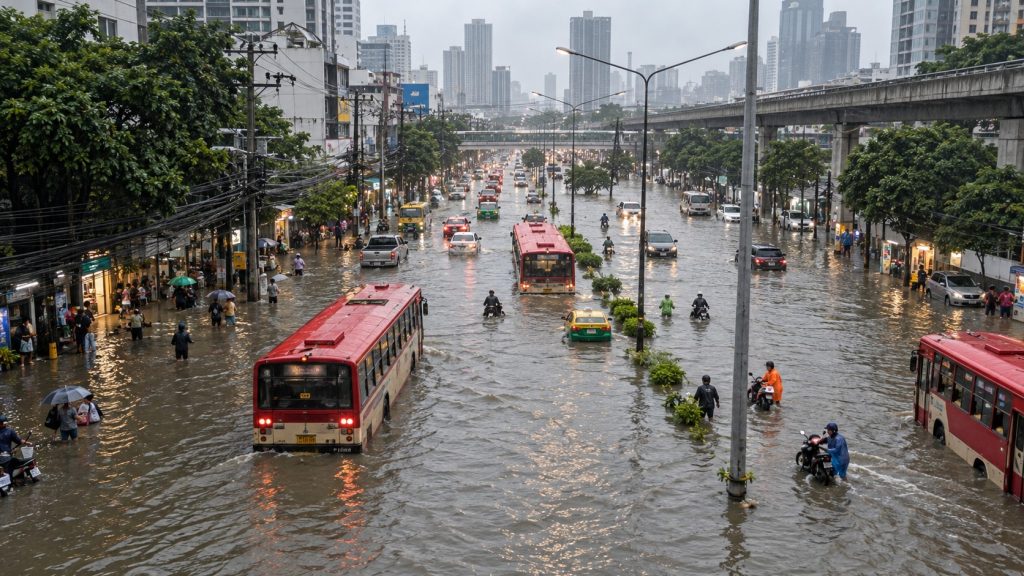
In 2026, the meaning of a "water crisis" looks very different from one region to another. One part of the world is mobilizing huge sums for flood barriers and drainage tunnels to cope with extreme weather. Another is struggling over raw water supplies needed by cities, agriculture, industry and power generation. The challenge is no longer whether to invest. It is how to invest in ways that actually reduce risk.
The OECD report Financing Water Security (2026) warns that persistent underinvestment could leave the global economy facing average losses equivalent to about 8% of GDP by 2050, rising to 10 – 15% in low-income countries. This is more than a conventional damage estimate. It shows that water stress has moved from being a utility problem to a full-scale macroeconomic risk.
The World Bank has estimated that meeting the need sustainably could require cumulative investment of about $6.7 trillion by 2030 and $22.6 trillion by 2050. Yet the actual flow of capital is far smaller. A joint report by 10 multilateral development banks says only about $19.6 billion in water-security financing was approved in 2024.
With such a large funding gap between what is needed and what is actually available, capital allocation becomes decisive. The worst outcome is not simply a lack of investment. It is spending heavily on the wrong infrastructure in the wrong place, locking a city into decades of maintenance costs and eventually leaving it with stranded assets that never perform as intended.
Key Insight Water stress is not only an environmental problem. It is an economic risk capable of erasing part of global GDP growth. With investment needs measured in trillions of dollars and actual annual commitments still measured in tens of billions, water infrastructure decisions must emphasize precision and flexibility so that large capital outlays do not become long-term obligations that fail to solve the problem.
More money does not automatically mean more security when the wrong tool is chosen
Water infrastructure differs from ordinary roads or buildings because it has to operate alongside natural systems that never stand still. Rainfall, temperature, river flows, sea level, consumer behavior and land use all change over time. A project designed around historical averages can therefore face a very different reality by the time construction is complete.
The OECD argues that water investment should move away from treating each project as a one-off decision and toward investment pathways that can adapt when new environmental information emerges. That approach is very different from spending heavily on one large project and assuming it will continue working at the same level for another 50 years.
Before choosing a technology or an asset, the basic question has to be clear. What kind of risk is the system trying to manage? Too much water, too little water, deteriorating water quality or a surge in demand can occur at the same time, and each problem requires a different investment response.
Key Insight Water investment in the climate-change era can no longer rely on a one-size-fits-all model. Investors and policymakers need to move beyond the idea of making one large capital commitment and instead design flexible investment pathways that can adjust as future risks and environmental conditions change.
| Investment tool | Best suited to | Main strengths | Main limitations |
|---|---|---|---|
| Water Storage, including dams, reservoirs and storage systems | Store wet-season water for dry periods and reduce volatility in supply | Creates large reserves and can serve several sectors | Sedimentation, asset aging, ecological impacts and uncertainty over future inflows |
| Flood Barriers, drainage and levee systems | Reduce damage from urban floods and river flooding | Protects high-value economic areas and reduces business interruption | Design limits, continuing maintenance costs and residual risk |
| Modern Irrigation | Raise agricultural output and improve water-use efficiency | More precise water delivery and lower losses at some stages | Farm-level savings do not guarantee lower total water use across the basin |
| Water Reuse | Increase supply security for cities and industry | Provides a relatively steady source and reduces wastewater discharge | Requires treatment systems, reliable quality standards, viable pricing and public acceptance |
| Desalination | Create new freshwater supply in water-scarce coastal areas | Depends little on rainfall and improves supply certainty | High energy use, expensive systems and the need for careful brine management |
| Nature-based Solutions and hybrid systems | Slow and store water, reduce flooding and restore natural retention capacity | Delivers several benefits at once and can work with grey infrastructure | Requires land and time, needs continuous care and has more complex economic valuation |
Water Storage still matters, but storage cannot be treated as synonymous with dams
As climate volatility increases, storage remains central to adaptation. A resilient water system must be able to absorb excess water during wet periods and release it efficiently during dry periods. The World Bank report What the Future Has in Store argues that the world is facing a widening storage gap as demand rises while existing storage capacity deteriorates.
Over the past 50 years, more than 27,000 billion cubic meters of naturally stored freshwater in glaciers, snow, wetlands and floodplains has been lost. At the same time, human-made reservoirs are losing capacity through sedimentation, while aging infrastructure is entering a period in which major rehabilitation and maintenance are increasingly necessary.
The question is therefore no longer simply whether more dams should be built. Each basin needs to consider a broader storage portfolio. In some places, large dams may need to work alongside smaller reservoirs, ponds, wetlands, groundwater storage and more flexible operation of existing assets.
The advantage of a portfolio is diversification. If rainfall patterns change and a major dam no longer performs as expected, communities and economies can still rely on other storage sources and retention areas to absorb part of the shock.
Flood Barriers can reduce losses, but there is no such thing as 100% flood protection
Cities still need drains, tunnels, pumping stations, levees and flood barriers because urban areas concentrate both assets and economic activity. Preventing a single major flood in a high-value district can sometimes avoid losses that exceed long-run construction costs.
Since 2019, the World Bank has supported 69 urban flood-resilience projects across more than 58 countries, with commitments of about $4.4 billion. One example is Can Tho in Vietnam, where a hybrid flood-management system combines grey infrastructure with green corridors. The project protects more than 422,000 people and is estimated to avoid about $10.7 million in flood losses each year.
Even successful flood infrastructure cannot defeat every possible event. Every structure has a design threshold. If rainfall or flood volumes exceed the assumptions built into the system, flooding can still occur. In some cases, a levee can also shift risk by pushing water toward neighboring areas.
Modern flood management therefore increasingly combines zoning, early-warning systems, retention areas and backup drainage routes. The objective is not to create a city that never floods. It is to reduce how often flooding occurs, how deep the water becomes, how long the economy remains disrupted and how quickly normal activity can recover.
Modern Irrigation can improve efficiency without necessarily reducing total basin water use
Agriculture accounts for more than 70% of global freshwater withdrawals, making irrigation one of the most important investment targets as drought risk rises. Drip irrigation, soil-moisture sensors and more precisely controlled delivery systems can materially increase output per unit of water.
Farm-level efficiency, however, does not always translate into basin-level savings. Both the Food and Agriculture Organization and the OECD have warned about the irrigation efficiency paradox. Farmers may use efficiency gains to expand cultivated area, increase the number of crop cycles or switch to more water-intensive crops, leaving total system water use little changed.
Return flow is another overlooked issue. Water that once flowed back into canals or recharged groundwater can fall after farm delivery becomes more precise. If policymakers measure success only by the volume pumped into farms, they may assume water has been saved even while downstream communities or ecosystems receive less.
Modern irrigation therefore needs to be paired with water accounting, allocation rules, withdrawal caps and close monitoring of actual basin use. Without those controls, a technology that looks efficient at farm level can increase pressure on the wider water system.
Water Reuse is turning wastewater from a liability into a new source of supply
One technology reshaping the economics of water supply is the treatment and reuse of wastewater. Cities and industrial areas have a major advantage because wastewater is generated relatively steadily and is often located close to new demand. That makes reuse less dependent on seasons and rainfall than surface-water sources.
The World Bank report Scaling Water Reuse estimates that municipal and industrial reuse could grow about eightfold by 2040, reaching around 430 million cubic meters per day. That would equal roughly one quarter of total municipal freshwater withdrawals and could create investment opportunities of as much as $340 billion.
Reuse offers more than additional supply. It can reduce pollution and ease pressure on rivers, reservoirs and aquifers. But it is not automatic. Successful projects need treatment standards suited to the final use, credible quality controls, separate distribution infrastructure where necessary and pricing that both providers and users can sustain.
A treatment plant without committed water off-takers can become an underused asset. Economic viability therefore begins with basic questions. Who will use the water, how far are they from the plant and what price are they willing to pay?
Desalination offers supply certainty, but that certainty comes with energy and brine costs
For coastal cities and arid countries, desalination can produce freshwater without waiting for rainfall. Advances in reverse osmosis and larger project scale have reduced costs substantially compared with earlier generations, allowing some countries to include desalination as part of a broader water portfolio.
A reliable source is not the same as a cheap or consequence-free source. Desalination plants use large amounts of electricity, exposing operators to energy-price risk. Projects also require intake systems and water pipelines, as well as strict management of concentrated brine to limit environmental damage along coastlines.
The World Bank therefore recommends assessing desalination and water reuse within a portfolio framework rather than forcing the two technologies into a winner-takes-all contest. A city may use desalination as dependable supply during severe drought while continuing to rely on surface water, groundwater and reuse in proportions that balance cost and risk.
Contract design is equally important. If a government signs long-term water-purchase agreements based on demand forecasts that prove too high, users and the wider economy may end up paying for unused capacity. If investment is too low, the city may lack a buffer during an extreme drought. These projects are therefore as much about economic risk management as engineering.
Nature-based Solutions are infrastructure, not a decision to simply let nature take care of itself
Nature-based Solutions do not mean leaving ecosystems unmanaged and hoping for the best. Economically, they are another form of infrastructure that requires design, investment and long-term management.
Wetlands, upstream forests, mangroves, retention parks and floodplains can perform functions that would otherwise require concrete. They can slow water, reduce peak flows, soften waves and storm surges and increase groundwater recharge. At the same time they can deliver co-benefits through biodiversity, lower urban temperatures, public space and better water quality.
Between 2012 and 2024, the World Bank supported about 250 projects using these approaches to strengthen climate resilience. Sixty-six completed projects benefited more than 9.5 million people and restored about 1.1 million hectares of ecosystems. Projects still under implementation are expected to reach another 19.4 million people and restore about 3.5 million hectares of natural and green areas.
Buenos Aires provides one example, where nature-based retention basins help reduce flood risk for more than 3 million people. In Beira, Mozambique, an urban park combined with mangrove restoration helps protect roughly 50,000 residents from flooding.
Nature-based infrastructure is not free. It may require large areas of land, ecosystems need time to mature, maintenance is continuous and many benefits do not have direct market prices. That makes economic valuation more complex than for a drain or a dam.
Key Takeaway The greatest value of Nature-based Solutions is usually not in replacing conventional infrastructure entirely. It often comes from combining them with grey infrastructure in a hybrid system that closes gaps and uses the strengths of both approaches.
Why do many expensive water projects deliver less value than expected?
Many water-infrastructure failures do not begin with faulty engineering. They begin with the belief that once construction is finished the problem is solved. In reality, life-cycle costs include operations, inspection, maintenance, sediment removal, energy, staff, data management and repeated upgrades as climate conditions change.
Several recurring problems keep large projects from meeting their goals.
- O&M is treated as a secondary expense. Governments may successfully finance construction but underfund operation and maintenance, causing assets to deteriorate early and deliver less than their designed capacity.
- Institutions work in silos. A dam may be operated mainly for electricity generation while a downstream city needs spare reservoir capacity for flood control. Without basin governance, the objectives of different agencies can conflict and create losses.
- Prices and incentives are distorted. Water tariffs that are too low reduce the incentive to conserve demand, while utilities may lack enough revenue to maintain and expand service.
- Investment relies too heavily on historical statistics. Designs based on past rainfall return periods or demand projections, without room for climate uncertainty, can become outdated before the asset reaches the end of its accounting life.
- Success is measured by project quantity. Kilometers of drainage pipe, numbers of dams or installed capacity do not tell policymakers whether flood risk has fallen, scarcity has eased or service reliability has improved.
Key Insight These problems support the OECD view that water finance should not focus only on increasing the amount of money. Existing capital has to work better, regulation and institutions need to improve, investment pathways need to remain flexible and additional sources of finance should be brought in only where revenue structures and risk profiles can support them.
What does effective water investment actually look like?
Water infrastructure should be judged by system outcomes rather than asset size. A good project does not have to be the largest. It has to reduce losses or improve water security at a reasonable cost and continue to function as conditions change.
- Start with the risk, not the technology. Define whether the goal is to reduce flood depth, shorten downtime, increase dry-season supply, slow groundwater depletion or improve water quality before choosing the tool.
- Count both CAPEX and O&M. Construction is only the starting cost. Appraisal must include energy, staffing, maintenance, sediment management and replacement costs over the asset's life.
- Use portfolios and redundancy****. A city should not depend on a single dam, desalination plant or tunnel. A diversified portfolio and backup routes for both supply and drainage reduce single-point-of-failure risk.
- Keep the plan flexible. Stage investments and define triggers for expansion as rainfall, demand, sea level or groundwater conditions move beyond agreed thresholds. This reduces the risk of building too much or too little too early.
- Measure avoided losses and reliability. Flood projects should be judged by avoided damage and how quickly the urban economy returns to normal. Supply projects should be judged by service reliability rather than nameplate capacity alone.
- Link infrastructure with governance. Technical efficiency achieves little without water-allocation rules, enforceable zoning, quality standards, pricing systems and data that allow decision-makers to see real conditions.
The World Bank's Lifelines report estimated that resilient infrastructure in developing countries can generate average benefits of about $4 for every $1 invested over the asset's life. This is a broad benchmark across several infrastructure sectors and is not a guaranteed return for every water project. It nevertheless illustrates why preventing disruption can cost less than repairing damage after systems fail.
For drought, the OECD estimates that global economic costs are increasing by around 3 – 7.5% a year. An average drought event in 2025 costs at least twice as much as one in 2000, and by 2035 costs could be at least 35% higher than today if the trend continues. Choosing not to invest is therefore no longer a cost-free option.
The deeper lesson is that water security has no single hero technology. Dams store water but do not solve demand. Drainage reduces flood depth but cannot handle flows beyond design limits. Irrigation can raise productivity but needs basin-level controls. Reuse adds supply but requires users and quality standards. Desalination improves certainty but consumes large amounts of energy. Nature-based Solutions add buffers but require land and maintenance.
Key Insight The most cost-effective answer is often a mixed system that combines several assets with data, demand management, land-use rules, maintenance and expansion plans tied to real conditions. Water security in this century will not come from building the biggest structure. It will come from building systems that keep working when the world no longer behaves like the historical average.
Key Takeaways
- The investment gap remains enormous. Water-investment needs are measured in trillions of dollars, while actual capital reaching projects remains far below the requirement.
- No single technology solves both floods and droughts. Dams, drainage, irrigation, reuse, desalination and nature-based infrastructure each have different roles and trade-offs.
- Project-level efficiency is not always system-level efficiency. Irrigation efficiency is a clear example. Without governance, better technology may fail to reduce basin-wide water use.
- Maintenance and governance are part of infrastructure. A completed asset without adequate budgets, data or water-use rules can deteriorate faster than expected.
- Good indicators measure outcomes. Avoided losses, service reliability, recovery from crises and the ability to absorb shocks matter more than simply counting projects or capital expenditure.