
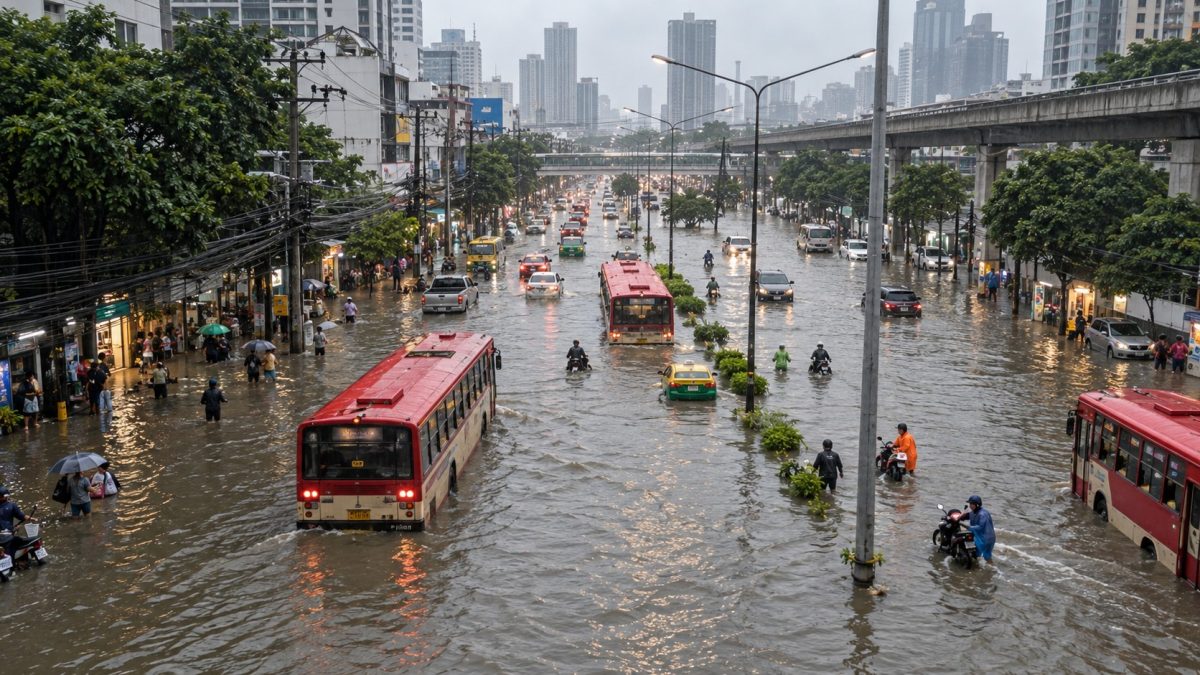
In late September 2026, Bangkok faced days of persistent heavy rain. Many districts slipped back into a familiar urban scene. Roads turned into waterways, traffic slowed to a crawl, shops and businesses closed early, employees could not reach their workplaces, and several public services were disrupted at the same time.
Reuters and other news organizations reported that accumulated rainfall in Bangkok reached around 320 millimeters in only three days, close to the city’s average rainfall for an entire month. The situation led Bangkok authorities to declare disaster areas across all 50 districts in order to speed up relief and crisis management.
The economic damage began to appear almost immediately. The University of the Thai Chamber of Commerce’s Center for Economic and Business Forecasting estimated the base-case impact of the floods at about 12.283 billion baht, with Bangkok bearing the largest economic loss at roughly 7.014 billion baht.
These are still early estimates based on an assumption that conditions improve within a short period. The important question is therefore not only “How many billions of baht did this flood cost?” We also need to ask “What kinds of damage are already included in that number?” and “What hidden costs have not yet appeared in the first days after the water recedes?”
For a large metropolis, flood damage is not limited to the value of submerged property. It accumulates every minute that people, goods, logistics systems, businesses, hospitals, airports and city services lose their ability to operate or move at normal speed.
What are we really measuring when we count flood damage?
Economic assessments of disasters usually separate the impact into two broad categories that describe very different economic effects. The first is “damage”, the physical destruction that can be seen and valued. The second is “losses”, the income and economic activity forgone while the urban system is disrupted and during the period before it returns to normal.
| Type of impact | Meaning | Examples in an urban area |
|---|---|---|
| Damage | Direct physical impact on assets, infrastructure and property | Homes, vehicles, machinery, inventories, roads and electricity systems |
| Losses | Activity, income or productivity lost during and after the event | Lost sales, lost working hours, production stoppages, higher logistics costs and emergency spending |
The World Bank’s assessment after Thailand’s major 2011 floods illustrates the distinction clearly. Total damage and losses reached about 1.43 trillion baht. More strikingly, economic losses accounted for about 56% of the total.
That share matters because it shows that much of the cost of a disaster does not stop with damaged assets. It also appears as interrupted production, lost income and productivity that disappears throughout the recovery period.
Another figure is equally important. About 90% of the damage and losses in 2011 fell on the private sector, while manufacturing alone absorbed roughly 70% of the total impact.
Those historical numbers do not prove that the 2026 Bangkok floods will be as severe as the 2011 disaster. They do show why an assessment based only on home repairs or vehicle repairs can badly underestimate the true economic cost of a flood.
Bangkok in 2026 flooded for only a few days, but the hidden costs started rising immediately
A city’s economic losses begin as soon as the rhythm of business is interrupted. Restaurants open late, retailers lose customers who cannot get through flooded streets, delivery vehicles take longer routes, employees miss work, and service businesses reduce their operating capacity. Every hour lost has an economic value even when no asset is permanently damaged.
The late-September 2026 episode also showed that the damage extends beyond streets with standing water. Reuters reported disruption at Suvarnabhumi Airport and difficulties for airline operations because staff could not travel to work normally.
This is one of the mechanisms of urban flooding that is often overlooked. National infrastructure may remain physically dry and technically operational, but if essential workers and support services cannot reach it through a flooded city, the wider economic system can still slow down.
For small and medium-sized businesses, hidden costs can appear faster and cut deeper. A firm with limited cash reserves may lose neither its building nor its machinery, yet it can lose cash flow after closing for only two or three days. Fresh ingredients and inventories may spoil, daily workers may lose income, while fixed costs such as rent, some wages and interest expenses continue regardless of the water level.
This is why an initial damage estimate is only a snapshot at one point in time, not the final bill that the economy will pay. The real loss depends on how long flooding remains, how quickly transport systems recover, how many firms can reopen, and, most importantly, how much lost revenue can be recovered once the water has gone.
Why Bangkok flooding is not just a local problem
Bangkok is not simply Thailand’s largest city. It is also the country’s most concentrated center of economic activity. The World Bank’s 2026 Thailand Cities of the Future report states that Bangkok generates close to half of Thailand’s economic output and that its economy is many times larger than Chiang Mai, the country’s second-largest major city.

In normal times, this concentration brings enormous economic advantages. Businesses and workers are close to one another, while mass transit, finance, corporate headquarters, labor markets and supplier networks are tightly connected. During a crisis, the same strength becomes a vulnerability when several of the city’s core networks stop working at once.
The 2011 floods demonstrated this risk to the world. Many of the hardest-hit industrial estates were in provinces surrounding Bangkok rather than in the city’s central core, yet production stoppages in electronics and automotive components disrupted the global supply chain. Damage in Bangkok and its surrounding region can therefore spill into a national crisis that weakens exports, manufacturing and foreign-investor confidence.
In the economics of urban disasters, this is concentration risk. The rule is simple but harsh – the more people, assets and high-value activity a metropolis concentrates in one place, the more economic damage even a geographically limited flood can produce.
Why do tunnels, canals and pumps still lose to Bangkok floods?
The answer is not that Bangkok has no drainage system. On the contrary, the city has a large water-management network. Before the 2026 rainy season, Bangkok’s Department of Drainage and Sewerage reported more than 6,854 kilometers of drainage pipes, five major drainage tunnels, 207 pumping stations, 244 water gates and another 371 pump wells.
The central constraint is capacity. When an intense burst of rainfall sends more water into drains, canals, pumping stations and discharge points than they can carry, water has nowhere to go except the urban surface, even if every machine is operating at full capacity.
The problem becomes worse when several bottlenecks appear at the same time. Rain falling over a business district may reach a canal, but if the canal is already high, pumps must work harder. If the final outlet is also constrained by high tide or a high Chao Phraya River, drainage efficiency falls again. What looks like a simple line on a map is actually a complex and fragile network in which each point affects the others.
Actual performance is also reduced by rubbish, construction obstructions and maintenance constraints. Bangkok’s drainage department said that in 2026 it planned to clean 3,811.7 kilometers of drainage pipes, about 55% of the total network. That figure reflects a basic truth of infrastructure investment – the cost does not end when construction is completed. The system needs operating and maintenance budgets, as well as staff, every year to keep its designed capacity available.
That is why JICA’s work on a new Urban Drainage Master Plan for Bangkok has an economic significance beyond engineering. Old assumptions about rainfall, land use, population density and the acceptable level of economic damage have all changed since much of the city’s drainage infrastructure was designed decades ago.
A concrete city changes the economics of flooding, so the same rain can become more expensive
Urban flood risk does not intensify because of rainfall alone. The physical structure of the city determines where water moves and how fast. A 2024 study tracing land-use change across Bangkok and its metropolitan region over three decades found that built-up land expanded from around 20% of the study area in 1992 to almost 45% in 2022.
Over the same period, the area exposed to flooding expanded from about 649 square kilometers to more than 1,681 square kilometers. The study shows that urbanization has continued to move into flood-prone areas even after Thailand’s costly experience in 2011.
When land that once absorbed or slowed water is replaced by roads, buildings, parking areas and other impervious surfaces, rain runs across the ground more quickly and reaches drains and canals in a shorter period. At the same time, the loss of wetlands, ponds and natural waterways removes the natural buffer that once held water before it reached the main drainage system.
The OECD has described the same structural problem in Bangkok and neighboring provinces. Agricultural land, wetlands and retention areas have been converted into residential developments, commercial zones and industrial estates. The result runs in two directions at once – the city’s water-storage capacity falls while the value of assets placed in the path of water rises.
This creates a counterintuitive truth in disaster economics. The same amount of rain can produce much greater economic damage when a city contains more high-value assets and economic activity, especially when they have been built in former retention or flood-prone areas.
Land subsidence, high tides and extreme rainfall are becoming a compound risk
Bangkok sits on low-lying terrain, so flood risk is not determined by rainfall over the city alone. Upstream water, river levels, high tides and land subsidence can occur together and compress the safety margin of the drainage system.
A 2024 study using InSAR satellite technology and modeling for Bangkok and surrounding areas found average ground subsidence of about 7 millimeters a year. Some scenarios indicate that rates could exceed 9 millimeters a year in the near future. The rate varies by location, so a single number should not be treated as representative of every district.
Economically, subsidence does not need to push the whole city below sea level before it becomes costly. A smaller elevation difference between urban land and receiving water can already make gravity drainage harder. That creates a long-term hidden cost. The city must rely more heavily on pumping, spend more on energy, and commit more capital expenditure to raising, repairing and upgrading infrastructure. At the same time, the OECD expects Thailand to face more frequent and severe floods and droughts, while research on Bangkok’s future flood risk points to increases in average rainfall and rainy days alongside declining vegetation. When these vulnerabilities reinforce one another, events once treated as exceptional can become more frequent.
This is why compound risk has become an economic issue. A city may cope with heavy rain when river levels are low, with high tides when there is little rain, or with high water when enough storage remains. But when several adverse conditions arrive together, the city’s remaining capacity can disappear very quickly.
The costs that remain after the water recedes
Physical damage can be photographed and recorded. A large share of economic losses, however, never appears in news images. This is why the true cost of urban flooding can far exceed the repair bill.
- Time and productivity – Hours lost in traffic, postponed business meetings and delayed deliveries reduce economic output without leaving visible physical damage.
- Labor income shock – Daily workers and hourly wage earners can lose income immediately when the city’s transport system stops functioning, unlike some office employees who can shift to working from home.
- SME liquidity pressure – Small businesses may reopen quickly but still have to finance repairs and restock inventories while sales remain below normal, creating cash-flow shortages and heavier debt burdens.
- Supply chain and logistics disruption – Sudden route changes raise fuel, overtime and delivery costs. Agricultural products and other perishable goods can lose their economic value before reaching consumers.
- Public budget opportunity cost – Governments and local authorities must divert money to pumping, rescue operations, cleaning and infrastructure repair. Those funds are no longer available for other urban development projects.
- Financial risk premium – Repeated flooding can change how an area is priced for risk, raising insurance premiums, tightening lending conditions, lowering property valuations and influencing business location decisions.
The 2011 disaster also showed that low-income households face particularly high risk. They can lose income quickly while having the least access to formal credit for recovery, pushing some toward informal borrowing. Urban flooding therefore does more than destroy assets. It can widen financial inequality.
What kind of infrastructure investment actually reduces losses?
A resilient city cannot rely on only one form of infrastructure. Large drainage tunnels may be necessary in some areas, but bigger pipes alone cannot solve problems rooted in land-use change, population density and shrinking water-retention space. Effective investment has to diversify risk and combine several tools.
- Grey infrastructure – Drains, canals, water gates, pumping stations, tunnels and flood barriers remain essential, but their design standards must reflect current rainfall and water-level data. Operating and maintenance budgets also need to be protected throughout the life of each project.
- Green and blue infrastructure – Parks, wetlands, ponds, retention areas and permeable pavement act like a sponge, slowing and temporarily storing water before it reaches the main drainage network all at once.
- Multi-purpose retention space – Public space can also manage water during emergencies. Bueng Sikan, for example, had its storage capacity increased from 50,000 to 150,000 cubic meters, showing how one urban space can deliver both economic and social benefits.
- Risk-based land use – Risk mapping and controls on development in retention areas or places with poor drainage can prevent the creation of new losses. Flood investment is not only about pumping water away faster. It is also about stopping high-value assets from being concentrated where infrastructure capacity is limited.
- Data and early warning – Weather radar, water-level sensors, forecasting models and traffic data can help the city drain water earlier and warn businesses in advance. Even a few hours of extra time can save inventory, reduce logistics losses and give firms time to activate emergency plans.
- Financial and insurance instruments – Disaster insurance, emergency funds and pre-arranged recovery credit can provide a buffer that helps businesses and households restart faster and reduces the risk that a natural disaster develops into a long-term debt problem.
The macroeconomic question should therefore not stop at “How much does this project cost to build?” It should be weighed against the economic damage that the project can prevent over its lifetime.
A project that looks expensive today may still generate a very large economic return if it prevents firms from closing, preserves working hours, protects assets and reduces transport disruption across repeated future floods. Its real return on investment can be far greater than the number shown in the construction budget alone.
A city does not have to eliminate flooding, but it must stop flooding from becoming an economic crisis
Designing a major city to be completely flood-free may not be economically realistic. Building infrastructure capable of withstanding the most extreme event in every location would require enormous investment, and weather events can still exceed design standards.
A more useful goal is urban resilience – limiting damage and shortening recovery time. The business questions then become practical. How many hours should it take to reopen a key economic road? Can hospitals remain accessible? Which central business districts carry the highest opportunity cost if they stop operating? Which areas can the city allow to hold water temporarily in order to protect more important economic zones?
Seen through this framework, flooding moves from being only an engineering constraint to becoming a problem of resource allocation. Every baht spent on drains, tunnels, ponds, parks, early-warning systems or land-use planning should be judged by its ability to protect lives and preserve economic value, not simply by the number of projects completed.
Bangkok is a clear case, but the same equation is emerging across major Asian cities. Urban growth is accelerating, asset values are becoming more concentrated, impervious surfaces are expanding, while weather is becoming more volatile. Rainfall that was once treated as a seasonal event can therefore become a national economic risk.
Ultimately, rainfall is the natural hazard, but an economic crisis is created by what cities place in the path of water. The cost depends not only on the severity of a storm, but also on whether the city has retention space, redundancy, warning systems and an economic structure capable of absorbing the shock.
Executive Summary
- How much did this flood cost? The initial estimate is around 12 billion baht, but the final economic bill is likely to be much larger.
- Hidden costs are larger than they look. Early estimates are only the tip of the iceberg. Lost income, disrupted logistics and recovery time can be worth far more than the physical repair bill.
- Compound risk is squeezing the system. Bangkok’s vulnerability is not simply about whether it has drainage. Extreme rainfall, dense urban development, lost retention space, high tides and land subsidence can all reduce infrastructure capacity at the same time.
- The spillover can become national. The more economic activity is concentrated in the capital, the greater the potential for Bangkok flooding to affect GDP, manufacturing, exports, tourism and supply chains across the country.
- Investment has to be integrated. Sustainable loss reduction cannot rely on tunnels and drainage pipes alone. It requires water-retention space, risk-based land-use planning, data and early-warning systems, and financial risk-management tools working together.


